Why is natural exploration still struggling? Rethinking subsurface exploration through integrated modeling


The underground is not a static place. So why do we model it like one?
Imagine trying to understand a city by looking only at its buildings, without considering the people moving through it, the traffic flowing beneath it, or the countless interactions happening every second.
You would get a picture of its structure, but miss so much of what makes it work. The same is true underground.
Beneath our feet lies a constantly evolving world. Fluids migrate, rocks transform, and chemical and microbial reactions reshape underground resources. Understanding these interactions is essential to predicting what the subsurface holds and how it may evolve.
A world that never stands still
For decades, geological modeling has helped scientists reconstruct the history of sedimentary basins, understand fluid migration and identify potential reservoirs. But understanding where fluids accumulate is only part of the story.
What happens to them along the way? How do they interact with surrounding rocks? What happens when microorganisms enter the equation?
Consider natural hydrogen. Even when geological conditions favor its generation, hydrogen may migrate, react with minerals or be consumed by microorganisms before it can accumulate in a reservoir.
Similarly, in Oil & Gas exploration, chemical and microbial processes can influence fluid composition, including the presence of hydrogen sulfide (H₂S), a highly toxic and corrosive gas that represents a major operational risk.
These examples illustrate a simple reality: understanding the subsurface requires more than knowing its geological structure. We also need to understand the processes transforming it.
When million of years meet minutes
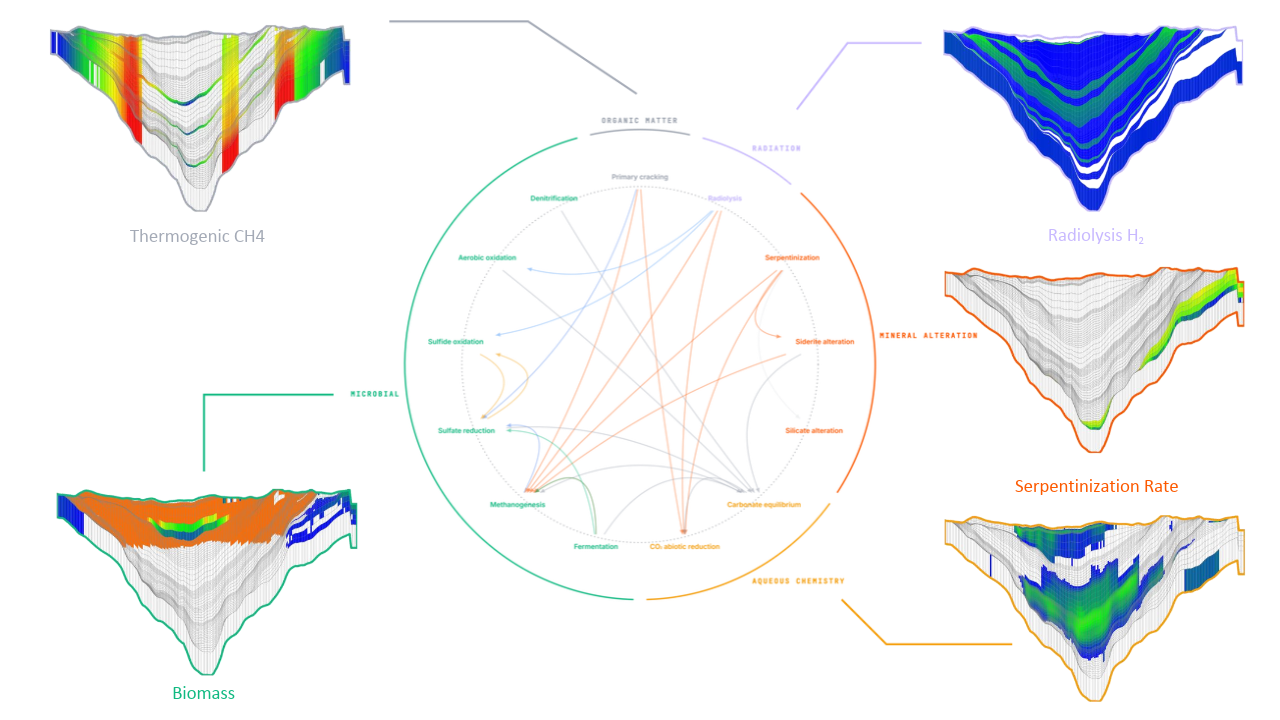
One of the greatest challenges in subsurface modeling lies in the radically different timescales at which geological, chemical and biological processes occur.
Natural hydrogen, for instance, can be generated through several geological processes, including water-rock reactions, radiolysis and the thermal maturation of organic matter, which can unfold over thousands to millions of years. Meanwhile, certain chemical and microbial reactions can transform or consume underground gases in a matter of minutes.
Yet these processes do not happen independently. They continuously interact, influencing the composition, distribution and evolution of subsurface resources.
The difficulty lies in capturing these interactions within a single simulation.
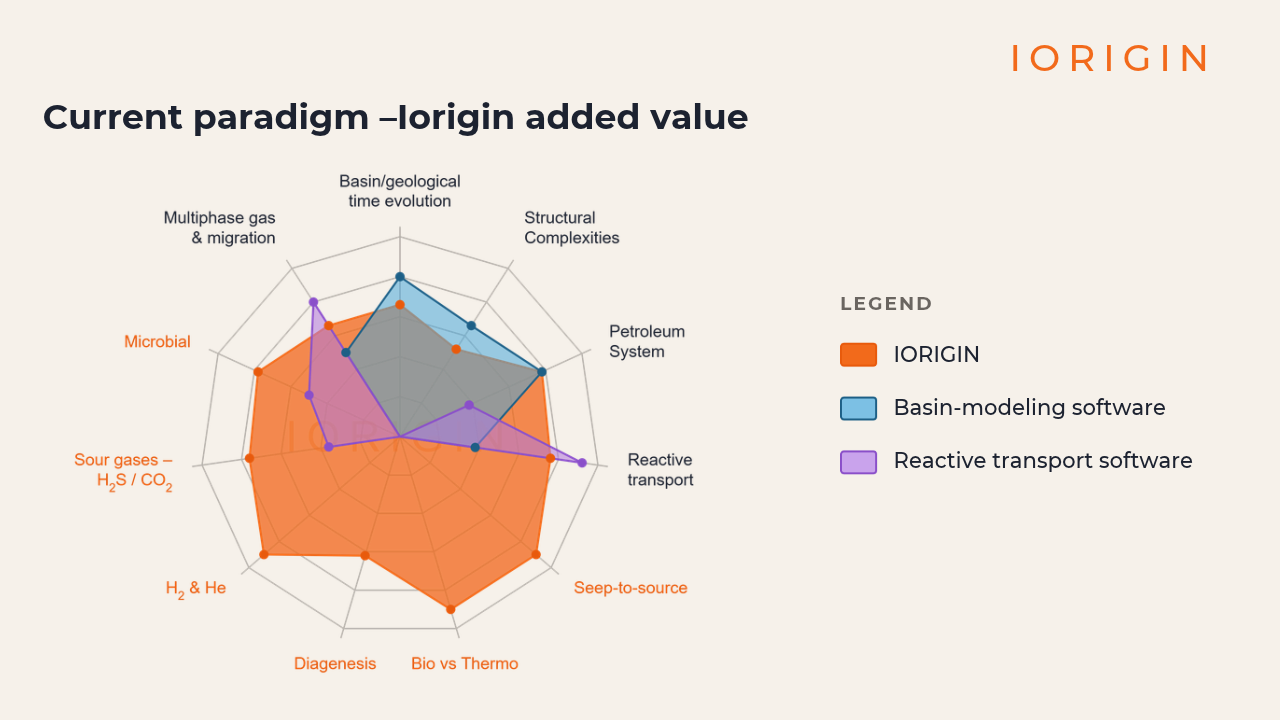
Traditionally, basin modeling has been used to reconstruct the geological evolution of sedimentary basins over millions of years, while reactive transport modeling focuses on fluid movement and the chemical reactions occurring underground.
Both approaches provide valuable insights, but combining them is computationally challenging, particularly because of the enormous differences in the timescales involved.
As a result, these processes are often modeled separately, making it difficult to fully capture how geological evolution and geochemical transformations influence one another.
The challenge is no longer just to understand these processes individually, but to simulate how they interact as part of the same evolving system.
One subsurface. One connected model.
This is precisely the scientific challenge that HyReveal set out to address.
At the heart of IORIGIN lies a patented technology that couples basin modeling with reactive transport in a single simulation engine. By bridging processes unfolding over geological timescales with much faster chemical and microbial reactions, IORIGIN provides a unified view of subsurface dynamics, with a unique depth of analysis that conventional approaches struggle to achieve.
For natural hydrogen exploration, this means looking beyond where hydrogen might be generated to better understand what happens to it afterwards. How does it migrate? What reactions might consume it? Under which conditions could it accumulate and remain preserved underground? Addressing these questions is essential to assessing the potential of a hydrogen system.
Beyond that, IORIGIN can predict sour gases, including H₂S and CO₂ and also characterizes the nature, composition, volume and quality of fluids, as well as reservoir and seal properties (diagenesis), in 1D, 2D and 3D.
Designed to fit seamlessly into operators’ daily workflows, IORIGIN supports decision-making across different subsurface applications, from Oil & Gas exploration to geological CO₂ storage and deep geothermal energy.
Making advanced science accessible not only to supermajors but pure players ?
Advanced geochemical modeling has long been the domain of highly specialized teams. Setting up simulations, selecting the right parameters and interpreting results require expertise that not every company has in-house. As a result, these powerful methods can remain difficult to integrate into everyday exploration workflows.
HyReveal wants to change that. Alongside its physics and chemistry-based simulation engine, IORIGIN integrates an AI-powered geochemist designed to guide users through complex workflows, help them set up simulations and interpret results, even without a dedicated geochemistry team.
The ambition is not to replace geoscientists, but to give more of them the tools to explore questions that previously required specialist support.
Our mission : make natural hydrogen happen, with cutting edge science that anyone can put on work.